High and low, Shrink and grow
By James Gammon , Bipin Regmi, Jordan Watkins & Carson Whitt
INTRODUCTION
High and low, Shrink and grow was developed to provide a variety of users with a simple yet satisfying game-play experience. The player operates a ball that must roll around and collect multiple floating collectibles across the map, but in order to get to the majority of them you must change your ball’s size. For example, you may need to get up a flight of stairs that a smaller ball has difficulty traversing. However, by growing large enough you can go up the stairs almost as if it was a smooth ramp. Through obstacles like this our game creates a pseudo-sandbox experience for users, allowing them to utilize any combination of growing and shrinking in order to complete the level. We made a game that lets the user have fun in any way they want, there is no right or wrong way to advance in this game! Below is a short game demo that outlines the basics of High and low, Shrink and grow.
The video above showcases High and Low, Shrink and Grow. It begins at the beginning of the level and shows the player utilizing shrinking and growing mechanics to collect tokens. The video also shows off a variety of other features, but we do not want to spoil it if you have not watched it yet!
IDEATION PERIOD
The Foundation
Before we had a concrete idea of what we wanted to achieve with our game we all decided on what development platform we wanted to use.We decided to implement our game with the Unity platform. Unity has a wide breadth of tutorials and general resources available which made it a strong choice for novice game designers like ourselves.

the ideas
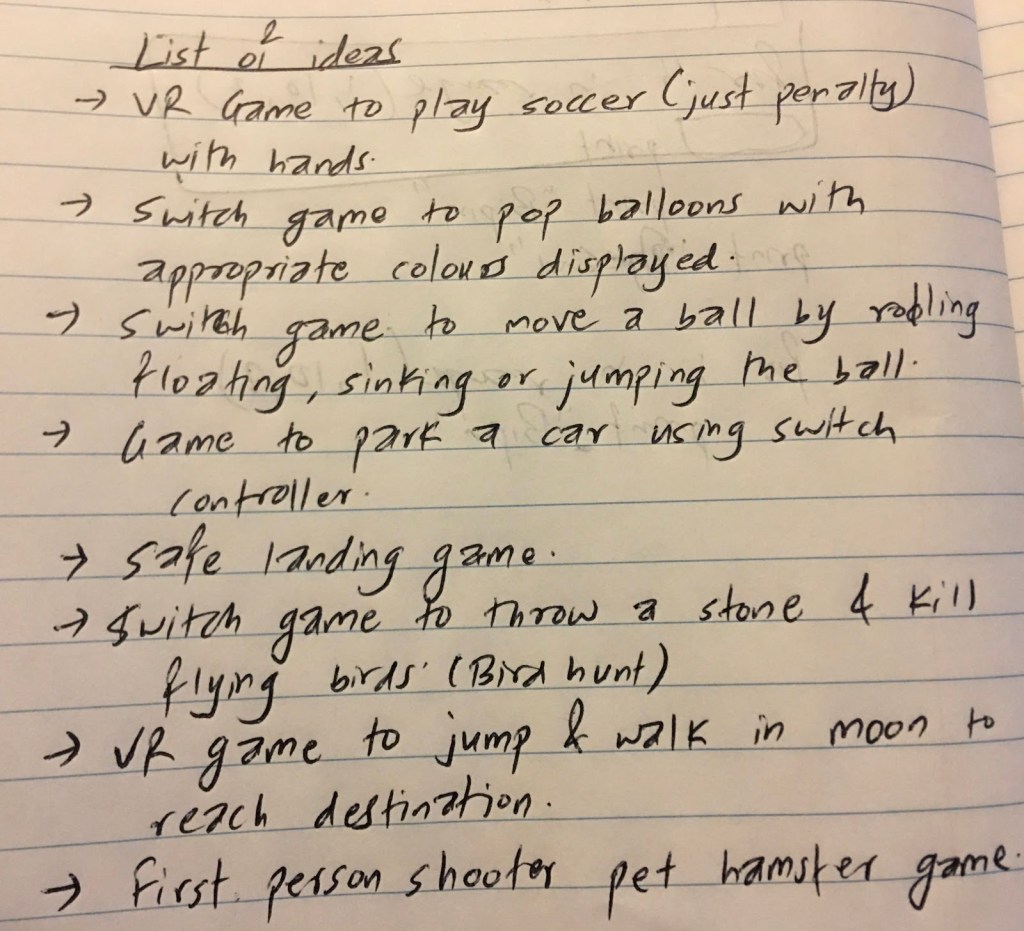
We conducted a twenty minute brainstorming session in which we dumped our ideas onto a piece of paper. This allowed us to produce a large quantity of ideas for discussion without deliberating on the specifics for the time being. Below is a brainstorming sheet with a list of our collective ideas.
the Refinement
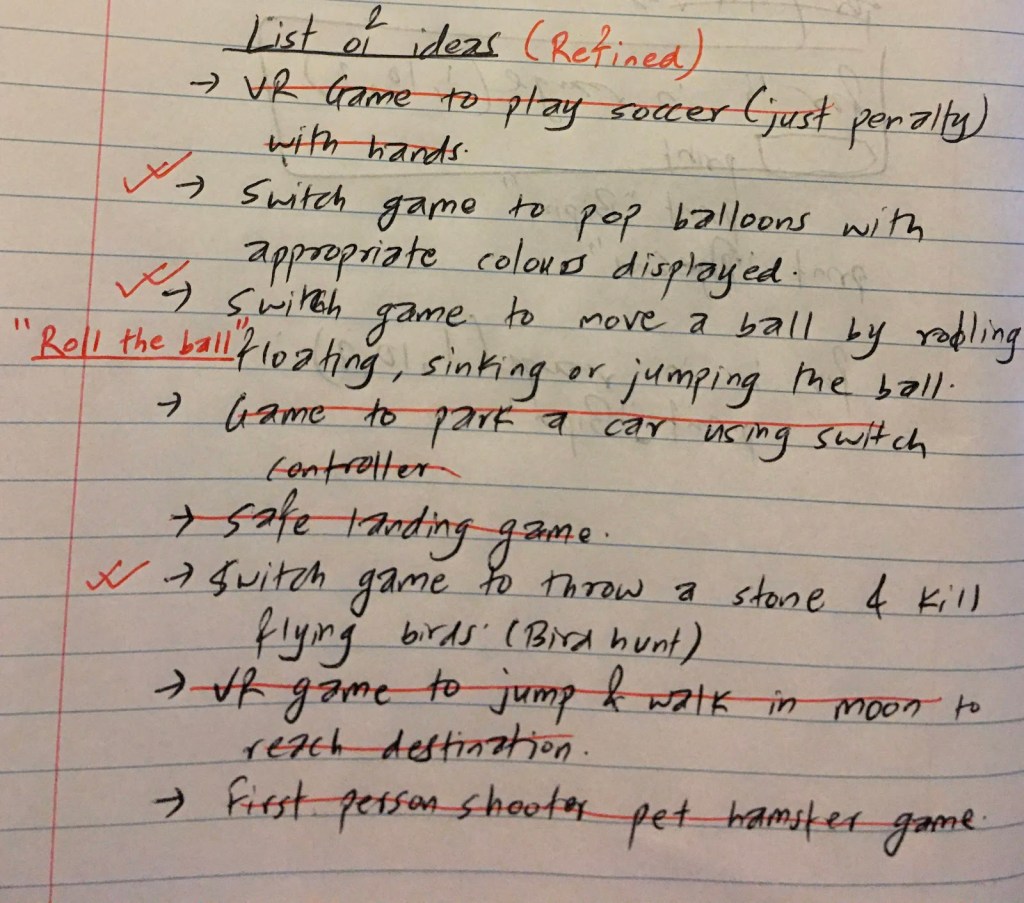
After brainstorming we moved into a stage of critique and refinement of our ideas in order to get a better picture of what ideas were viable and which were unrealistic. During this stage we were able to remove some of the ideas that were unreasonable for the project such as the idea “First Person Shooter, Pet Hamster Game”. We did some research and realized that games like these take a lot of complex features to get working properly including hitboxes, multiple collision objects, and player weapon vectors. The majority of these features were outside the scope of our abilities primarily due to the time restraints of this project.
The Decision
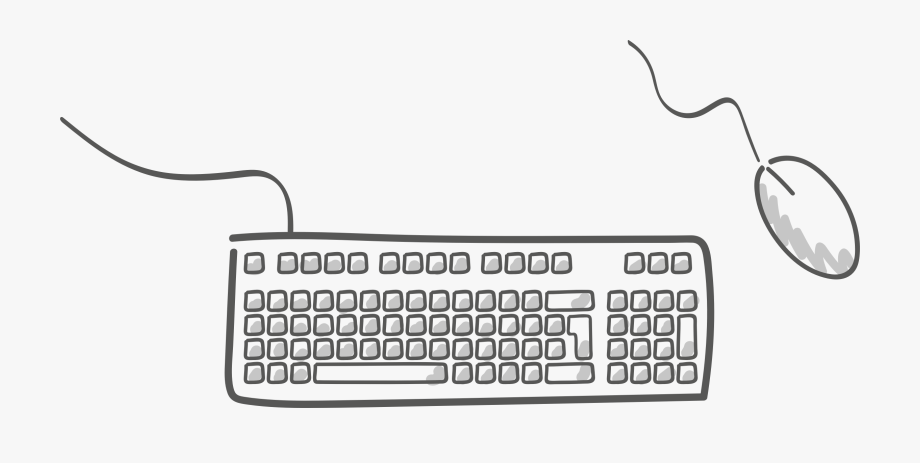
After refining and shortening our list of ideas we unanimously decided on a 3D rolling ball game where the ball has to grow and shrink in order to move through obstacles and progress through the level. We want the experience to be fun for a large audience so we aimed to make the game exploitative and challenging in order to strike a balance that would suit casual and hardcore gamers alike. While coming to this decision we also decided on using a keyboard and mouse as input technology for this game. We went with this technology because all of us had played video games with a keyboard/mouse in the past so we thought that it would be easier for us to understand how a typical user may interact with the game mechanics.
PROTOTYPING
tHE video prototype
Before we began designing and implementing features for our game we made a video to encompass the general feeling that we wanted to elicit from our users. We wanted users to feel calm and collected all while having fun playing High and Low, Shrink and Grow. We want them to express their creativity and wanderlust in any way possible through our game.
Working on the Game
Creating the game was a fairly smooth and interesting process. We had team meetings where we would play the current version of the game and get input from each other in order to refine it more and more. Throughout this iterative process we found some things that worked really well and some other things that were less than desirable.
One of the main features we had trouble working with was the growing and shrinking aspect of the player object in relation to the camera. When we first implemented the changing of the ball size the ball would fill the entire camera view making it almost impossible to tell where you were going as a larger ball. Similarly for the smallest ball, it would be so tiny relative to the camera view that you couldn’t even see it. To fix this we did some research and found some intuitive ways to help the camera stay in sync with the ball’s size. We did this through changing the FOV (field of view) of the camera while changing the ball’s size so that the ball would always fill an appropriate amount of the window.
One feature that worked very seamlessly was the growing and shrinking mechanic itself. We had a function mapped to the scroll wheel of the mouse so that when you scrolled up you would grow by 5% and when you scrolled down you would shrink by 5%. We were originally thinking of binding the growing and shrinking of the ball to the ‘+’ and ‘-’ keys, but the natural feeling of the scroll wheel worked far better for our purposes.
One feature that we briefly worked on was the changing of player colors. We wanted the player to be able to choose a color that best suited them so we mapped some basic solid colors to a function and let the user change the ball color with the space key. We were able to implement this feature, but it did not turn out exactly how we intended. We were more focused on the main functionality of the game so we didn’t get to extrapolate on this any further but it is very high on our list of future improvements.
User Testing
We spent one day of class time presenting High and Low, Shrink and Grow to our professor and peers. This gave us the opportunity to receive feedback on our game from a non-developer point of view. Many people said that they enjoyed how open and free it felt. Having the freedom to do what you choose was a big inspiration for this game so we were glad to hear that from our peers. Many people also congratulated us on our map design and how it incorporated obstacles that aren’t too hard but made them use the growing and shrinking mechanics at hand.
Although we didn’t get a wide variety of critique, we did have a lot of individuals offer the same suggestion; implement a restart button. If people fell off the main platforms the only way to start back from the beginning was to restart the game by closing it and reopening it. As the actual game designers, our group didnt think about the annoyance to the normal user that not having a reset button could be.
Quickly after user testing we went on to add a reset button that would move the player’s ball back to the starting platform via the r key. After fixing this simple oversight we let a few friends and family play and they had no complaints about the game whatsoever. They only wished that there were more levels to play through which we plan to introduce if we continue along our current development path.
Final Prototype
After collecting input from our peers during the testing stage we fixed the few issues and critiques that they had reported. We confirmed this as well by letting others outside of our classroom play the game and we only got smiles and praise. Due to this we were able to end up with a far more refined final prototype, however, that is not to say that it is a perfect game.
High and Low, Shrink and Grow has a few drawbacks. One being the lack of natural audio. The game has no sound effects whatsoever. We originally put this off to the side in order to focus on more fundamental aspects of the game, but after doing user testing we didn’t receive any negative feedback regarding sound or the overall artistic style of the game so we kept focusing on the physical features instead. If we had not initially overlooked this feature, with more time and research, we would have certainly prioritized the implementation of appropriate sound effects and background music. In our experience, having an appealing atmosphere in a game can really engage users, encouraging them to spend more time playing the game.
We were very happy with all of the main features of the game. The growing and shrinking of the ball was very clean and felt natural with the mouse wheel. The camera movement rotating around the ball and the camera movement with respect to the ball’s size all worked perfectly and gave our users plenty to play around with. Everyone who played enjoyed the level design and had enough difficulty advancing through the level to make it fun yet slightly challenging with the size related obstacles.
FINAL THOUGHTS
When we first began developing High and low, Shrink and grow, we had no idea that we would nurture such a passionate desire to see this game come to fruition. High and low, Shrink and grow captures the attention of users with a multitude of exciting features and game mechanics that each contribute a unique facet to this game’s exciting gameplay experience. It was through extensive criticism from peers, preliminary brainstorming stages, and focused development periods that we were able to reach the point that we are at now with this game. Although we have a large amount of possible improvements, we are content with how this game turned out in the amount of time and limited knowledge of game development that we have. As we continue to polish High and low, Shrink and grow, your feedback is essential to our process; We thank you for taking the time to review it and request that you feel free to provide critique or ideas in the comments below.
We thank you for taking the time to review it and request that you feel free to provide critique or ideas in the comments below.
 Welcome